Launch a projectile at an angle
Part I: Disreagrding the Atmosphere
This page originally compiled Mar 2007 by TFR
If we neglect the drag caused by the atmosphere, we already have what we need to analyze the motion of an object launched at an angle, i.e. with some vertical and some horizontal components. We will need to use these calculations for a first approximation of our rocket's flight after it has begun to move off of strictly vertical motion, starting to angle over and head downrange in the direction of its eventual orbit.
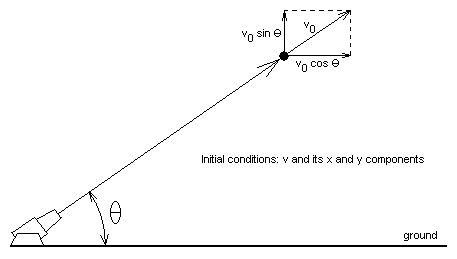 Let us call the launch angle θ, the launch velocity v0
The horizontal component of v0 is then
v0x = v0 cosθ
and the vertical component is
v0y = v0 sinθ
Since we are neglecting the atmosphere for this first approximation, vx will not be changing throughout our projectile's flight, but will remain constant at v0 cosθ. Vertical motion, on the other hand, will be subject to gravity throughout, which means the projectile will essentially be falling from the instant it takes flight. If we accounted for the drag of the atmosphere, both horizontal and vertical velocity would be slowed by it, and the motion would be quite different than that depicted here. More on that in "Atmosphere Part II".
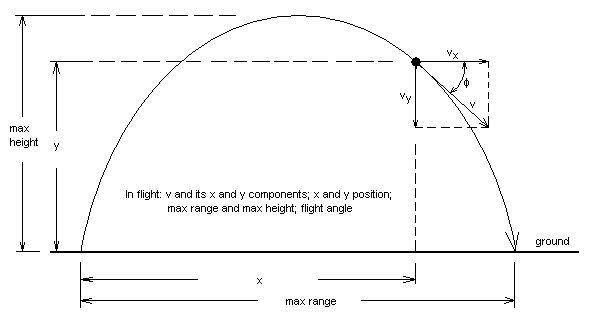 As is, our projectile follows an approximately parabolic curve, and
vx = v0x = v0 cosθ
vy = v0y + gt
v = √ vx2 + vy2
The projectile's position at any time t is
x = v0xt, and
y = v0yt + 1/2gt2,
and its flight angle, i.e its angle of motion with respect to the ground, can be found from
tanφ = vy / vx
We can calculate the maximum height reached by recognizing that the change in velocity required is simply v0y, and the time required is:
tH = v0y / g,
average velocity during the flight is:
va = (v0y + 0)/2,
and the maximum height reached is:
H = vatH = (v0y/2)tH = (v0y/2)(v0y/g) = v0y2/(2g)
The total time of flight will be 2tH, and the maximum range reached is just:
R = 2tHv0x = (2v0yv0x) / g
Examples:
A projectile is fired at an elevation angle of 30° and an initial velocity of 1000 feet/second. Disregarding the atmosphere,
What are the x and y components of the initial velocity?
v0x = 1000 cos 30° = 1000 × 0.8660 = 866 ft/s
v0y = 1000 sin 30° = 1000 × 0.5000 = 500 ft/s
At t=5 seconds, what is the position, velocity, and flight angle of the projectile?
x = 866 × 5 = 4330 ft
y = 500 × 5 + 1/2 × -32.2 × 52 = 2098 ft
vx = 866 ft/s; vy = 500 + -32.2 × 5 = 339 ft/s; v = √ 8662 + 3392 = 930 ft/s
φ = arctan 339/866 = +21.4°
What is the maximum height reached?
H = 5002 / (2 × 32.2) = 3882 ft
How long does it take to reach it?
tH = 500 / 32.2 = 15.5 seconds
What is the maximum range reached?
R = (2 × 500 × 866) / 32.2 = 26890 ft
Home
Last Revised: Mar 2007